Work in progress
Optimal minimum wages in spatial economies
with Gabriel Ahlfeldt and Tobias Seidel
Reject & Resubmit, Review of Economic Studies
We develop a quantitative general-equilibrium framework for the normative evaluation of minimum wages in spatial economies with monopsonistic labour markets. We quantify the model for German micro-regions and successfully over-identify its predictions against the effects of the 2015 German minimum wage observed in data. Simulating the model, we find that at low levels, spatially blind national minimum wages can increase welfare and spatial equity simultaneously. At higher levels, however, welfare gains are traded against employment losses and spatial inequality. Because regional minimum wages are not spatially blind, they can increase employment and welfare in a spatially neutral manner.

Measuring quality of life under spatial frictions
with Gabriel Ahlfeldt, Fabian Bald and Tobias Seidel
Submitted
Discussion papers: BSoE, CEP, CEPR, CESifo, IZA
ABRSQOL toolkit: GitHub directory
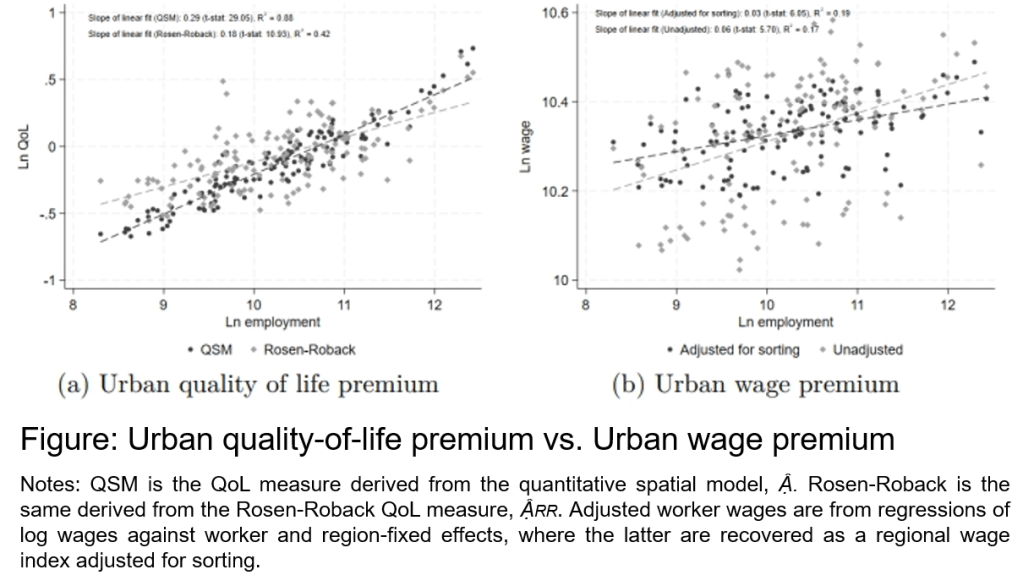
Using a quantitative spatial model as a data-generating process, we explore how spatial frictions affect the measurement of quality of life. We find that under a canonical parameterization, mobility frictions—generated by idiosyncratic tastes and local ties—dominate trade frictions—generated by trade costs and non-tradable services—as a source of measurement error in the Rosen-Roback framework. This non-classical measurement error leads to a downward bias in estimates of the urban quality-of-life premium. Our application to Germany reveals that accounting for spatial frictions results in larger quality-of-life differences, different quality-of-life rankings, and an urban quality-of-life premium that exceeds the urban wage premium.
Entry conditions and the transition from tertiary education to employment: a cross-country perspective
with John Moffat
Submitted
Discussion papers: IZA
This paper uses monthly data on tertiary education graduates in 19 European countries covering 2004-2017 from the European Union Statistics on Income and Living Conditions survey to assess the short-run effects of entry conditions on the transition into employment. Most previous literature has been unable to provide robust evidence of the short-run effects of entry conditions on unemployment durations, partly due to the use of annual data. This gap in the literature is important since it is well established that unemployment at the beginning of an individual’s career can have long-term „scarring“ effects. Using an instrumental variables approach, we find that a one percentage point increase in the unemployment rate reduces the hazard rate of transitioning from unemployment into employment by 6%. Consistent with previous evidence on cross-country differences in the rigidity of labour market institutions, the effect is stronger in southern European countries. Within this group, the effect is almost entirely due to negative effects on female graduates. We also find that adverse entry conditions lead to a lower probability of finding employment in a high-quality occupation, particularly in Southern European countries, which suggests that longer initial unemployment durations may play a mediating role in driving longer-term labour market outcomes.

The COVID-19 pandemic and international supply chains
with Eva Kleifgen and Ignat Stepanok
Submitted
Discussion papers: IAB
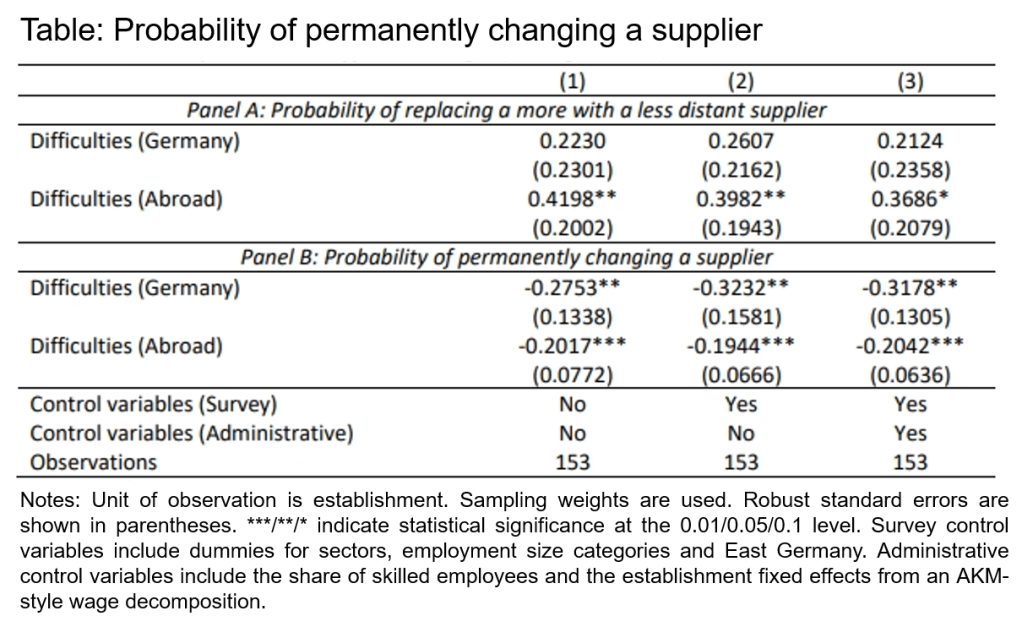
The Covid-19 pandemic has caused major disruptions in international trade and has raised concerns about adverse effects on international supply chains. Using a unique establishment survey matched with administrative data from Germany, we provide novel evidence on how establishments have adjusted their supply chains in response to pandemic-induced disruptions. We find that establishments that experienced difficulties in obtaining intermediate inputs as a result of the pandemic are significantly more likely to change their network of suppliers than establishments without such problems, especially if disruptions affected imports from abroad. Establishments experiencing supply chain difficulties are more likely to replace a distant with a closer supplier. However, these adjustments in response to the pandemic appear to be temporary.
Unemployment and worker careers: do different job opportunities matter?
with Mara Buhmann and Laura Pohlan
Submitted
Discussion papers: IZA
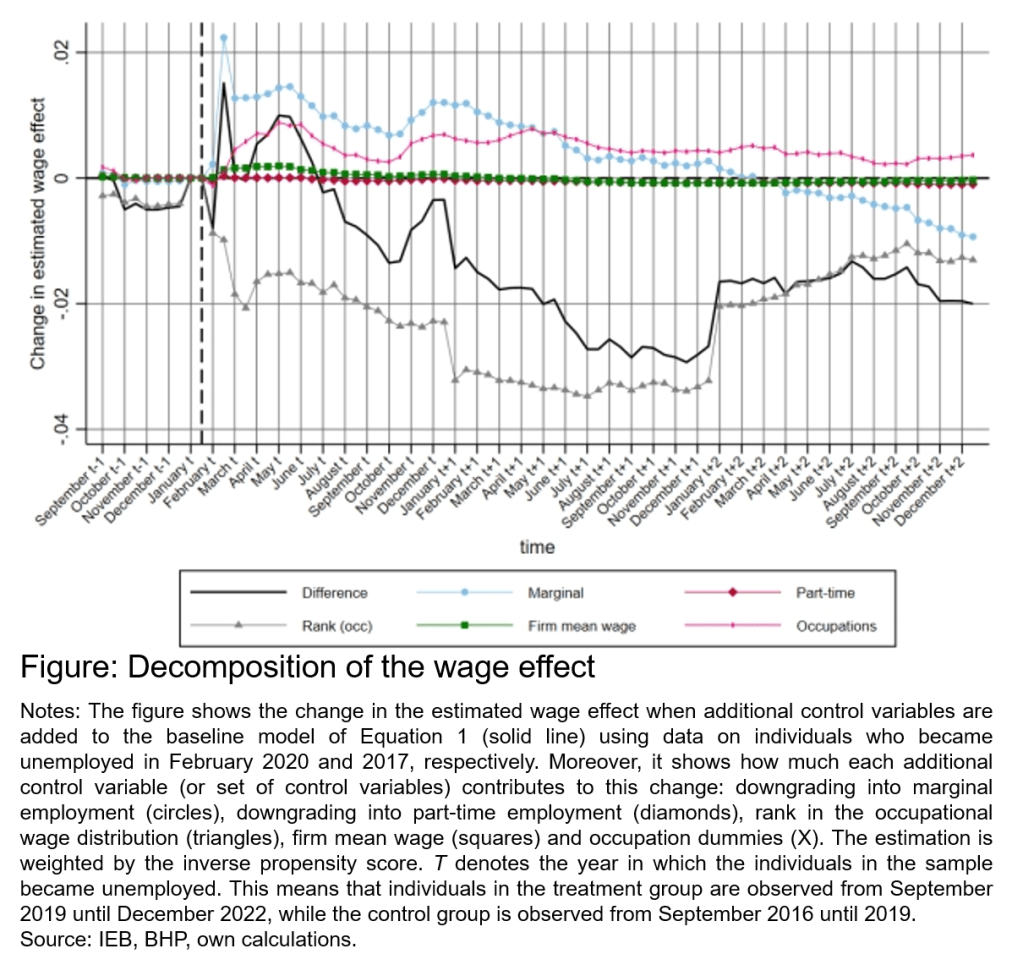
This paper exploits that the Covid-19 pandemic came as an unexpected shock that temporarily reduced the ratio of vacancies to seekers. We use this unique setting to understand the importance of job opportunities for the impact of unemployment on workers‘ careers. Compared to individuals who became unemployed under more benign conditions, we find greater and lasting adverse effects on earnings. We provide evidence that lower job opportunities lead unemployed individuals to take up jobs that are further down the occupation-specific wage distribution. Finally, we substantiate the importance of job prospects by using exogenous variation in the pandemic’s effect on occupations.
Job Mobility and Assortative Matching
with Luisa Braunschweig and Wolfgang Dauth
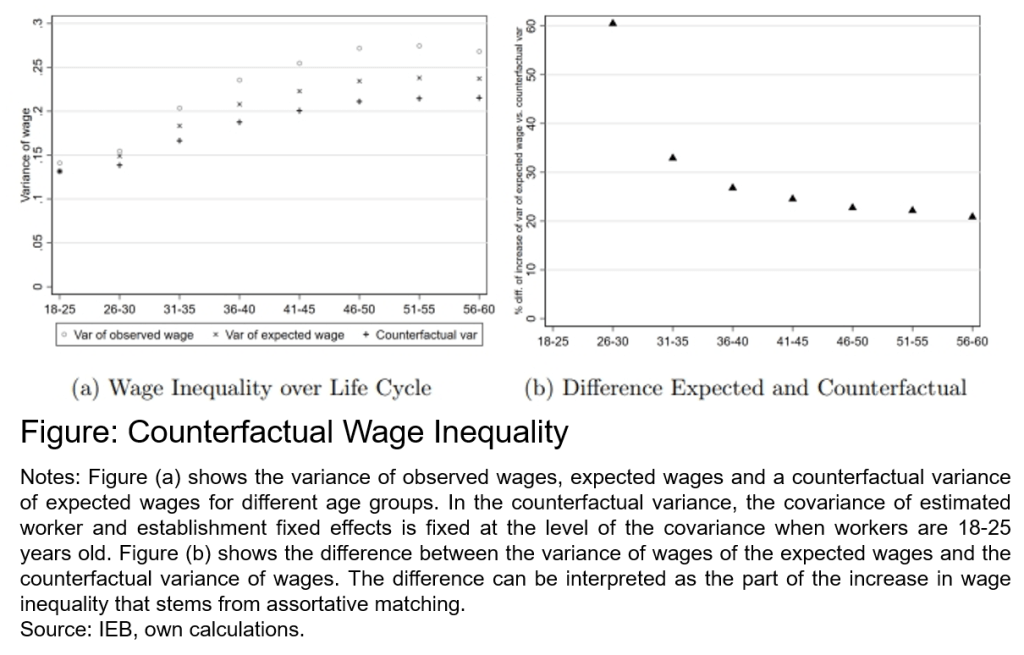
We examine the development of assortative matching over the career. Using German administrative data, we measure assortative matching as the correlation of worker and firm quality obtained from an AKM wage decomposition. We also introduce a novel measure based on the distance between worker and firm quality. Both measures indicate that matches become more assortative with each job move. In particular, for high-quality workers, this can be explained by job ladder models as these workers are found to move to higher-quality firms. The increase in assortative matching accounts for about 25% of the increase in life cycle wage inequality.
Transitions out of apprenticeship training during the COVID-19 pandemic
with Stefan Fuchs, Gabriele Wydra-Somaggio and Thomas Zwick
Changes in dynamic agglomeration effects over time
with Annekatrin Niebuhr and Cornelius Peters
Choosing where to train: the role of workplace amenities
with Anna Heusler
 Duncan Roth